
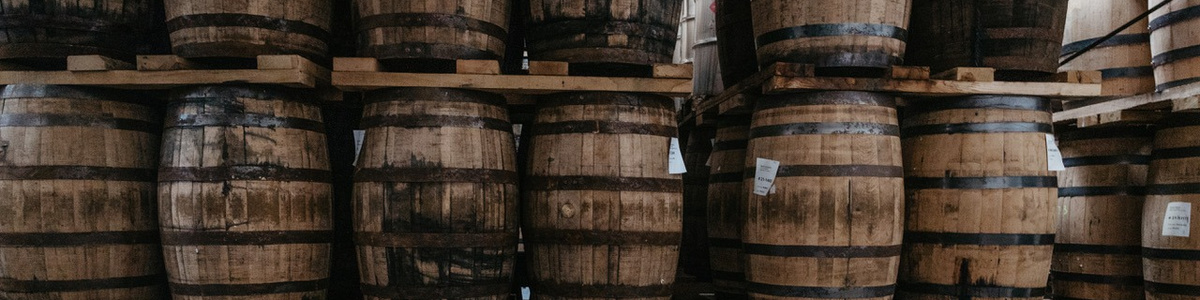
A whiskey blend can combine decisions made in several places. The original distiller establishes the spirit, maturation changes it in the barrel, and a blender selects which components will meet in the bottle. Louisville-based Barrell Craft Spirits provides published examples of that sequence, including releases that finish components separately before bringing them together.

The Company and Its Role
Joe Beatrice founded Barrell Craft Spirits in Louisville, Kentucky, in 2013. The company’s account of its origins describes a business built around sourcing and blending whiskey rather than constructing its own distillery at launch. Its team page identifies Tripp Stimson with distillery operations and Nic Christiansen with blending operations. A Barrell label therefore needs to be read at the release level: the location of the blending house and the places where the component whiskies were distilled answer different questions.
Finishing Components Before Blending
The company’s Whiskey Batch 005 record lists whiskey distilled in Indiana, Tennessee, and Kentucky, crafted and bottled in Kentucky at 118.4 proof. It identifies American white oak maturation and finishing casks that previously held bourbon, American brandy, amaro, and Cognac. The producer describes finishing the whiskies separately, then assembling a blend that also includes straight bourbon.
That historical batch illustrates a production choice rather than a recipe for every Barrell bottle. Finishing each component separately allows the final blend to combine whiskies with different cask histories. A reader can follow the listed origin, age, strength, and finishing information without adopting the producer’s flavor claims as an independent tasting result. The record supplies American white oak as a wood description, but it does not give an original toast profile or char number for every component cask.
Bottling Strength and an Additional Oak Stage
Barrell’s Foundation Series page identifies its non-cask-strength bourbon series as 100 proof. Foundation Double Barrel adds secondary maturation in new American oak. These details qualify any broad description of Barrell as exclusively a cask-strength producer: strength must be checked on the particular bottle, and a second oak stage must be identified on the particular release.
New American oak and a previously used finishing barrel describe different cask histories. They also leave further questions open. A new-oak statement alone does not disclose the cooperage’s complete heat treatment, while a reference to a former wine or spirits cask does not identify its oak species. The Foundation page does not provide a complete char-and-toast specification for the secondary casks.
Reading a Batch as a Production Record
For coverage in The Barrel & the Blend, the useful unit is the named release or numbered batch. Record the distillation origins, the documented wood, any previous cask contents, the order of finishing and blending, and the final strength. Keep unavailable specifications separate from confirmed details. That approach allows the reader to understand Barrell’s work while preserving the differences between bottles, including older batches that may no longer be available.
Batch 005 is a historical process example; current stock is not established.